


Today we moved further in towards the Amazon, leaving far behind us the shelf beyond which we had had depths of over 4,000m, and into shallower waters. First thing this morning, the Atlas Parasound P70 from Atlas Hydrographic GmbH was used by Rami Kalfouni to profile the sea bed, and results indicated a lovely muddy bottom at 750m, perfectly suited for station leader Mark Zindorf’s MUC deployment. Given the teething problems he and Sarima Vahrenkamp have experienced recently, and a seabed that has proved extremely reluctant to give up any samples, it looked like this could be a good station for the MUC.
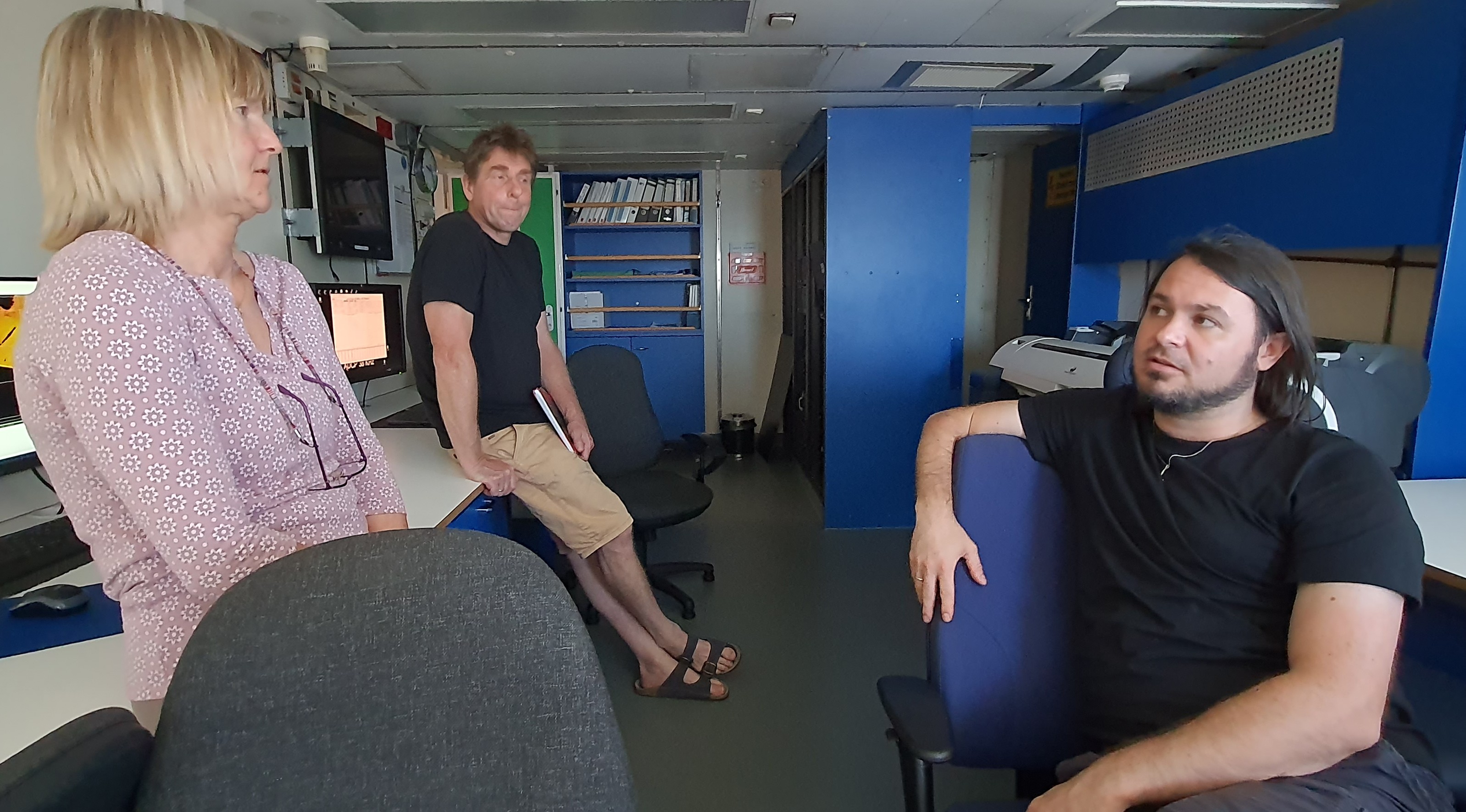
It was not to be. This time it was not the depth, nor the sea bed, nor the equipment that caused the problem, but the current, which turned out to be too strong to make a safe deployment possible. The positioning systems on the Meteor are wonderful, but nothing can prevent a heavy piece of equipment from moving laterally as it descends on a steel cable to such depths in strong or unpredictable currents. In addition, the MUC could embed itself in the sediment, the effects of the current making it impossible for it to be retrieved cleanly. With it acting as a type of anchor, the cable could be placed under strain, or perhaps the equipment could be dragged along the bottom before coming free. There was therefore a clear risk to the multicorer, and at worst to the winch or even to the ship itself and those in it. In short, deployment of the MUC and the Bottom Water Sampler had to be cancelled.

Frustrating as it is, everyone knows that safety comes first, and we are now looking forward to the next station, with no unpleasant currents and a sea bed that is… not too hard and not too soft, but just right!