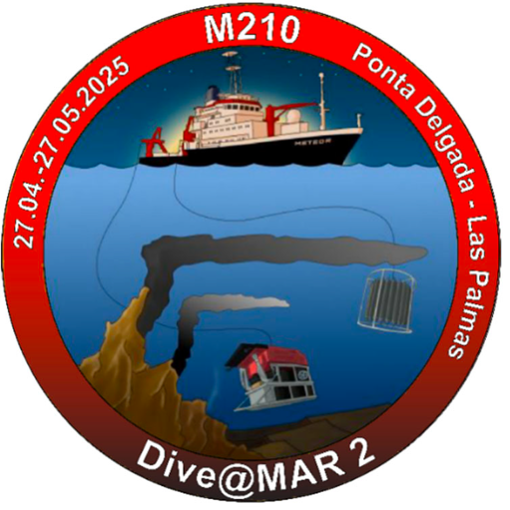
Shortly after April 28th, a multidisciplinary team of researchers set sail from Ponta Delgada aboard the research vessel RV METEOR, bound for one of Earth’s most geodynamically active marine environments: the Mid-Atlantic Ridge (MAR). Representing Constructor University and working within the research group led by Prof. Andrea Koschinsky, PhD candidates Eva-Maria Meckel and Eirini Anagnostou, along with BSc student Ana-Maria Munteanu, joined collaborators from the Max Planck Institute for Marine Microbiology (MPI-MM), MARUM – Center for Marine Environmental Sciences at the University of Bremen, and the Universities of Hamburg, Orléans, Lyon, and the Azores.
This scientific expedition (cruise number M210) focuses on a segment of the MAR between 36° and 38°N, a region known for intense hydrothermal activity. Here, hot fluids, which can reach temperatures of up to 350 °C, enriched in dissolved metals and gases are ascending through hydrothermal structures from the seafloor. The black smoke emitted by them consists of crystallized pyrite crystals. These systems support chemosynthetic ecosystems and give rise to metal-rich chimney structures, offering a unique window into the interactions between geological, chemical, and biological processes.
The Mid-Atlantic Ridge itself is a 16,000-kilometer-long divergent plate boundary that bisects the Atlantic Ocean, marking the slow but continuous separation of the Eurasian and North American plates. The M210 expedition builds upon findings from earlier cruises like the M190 cruise and aims to deepen our understanding of hydrothermal fluxes and trace metal dynamics within this tectonically active region. The geochemistry team at Constructor University is particularly focused on the fate and behavior of trace metals – including iron (Fe), manganese (Mn), copper (Cu), zinc (Zn), and rare earth elements (REEs) – within the hydrothermal system. These elements are mobilized through water-rock interaction at high temperatures and pressures, and their subsequent transport, speciation, and transformation within both focused vent fluids and diffuse flow zones play a crucial role in oceanic biogeochemical cycles.
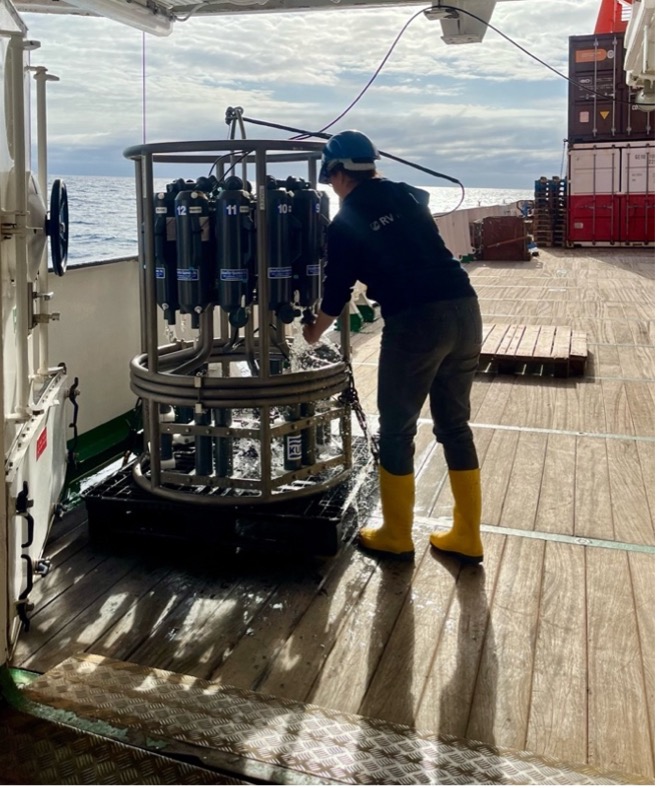
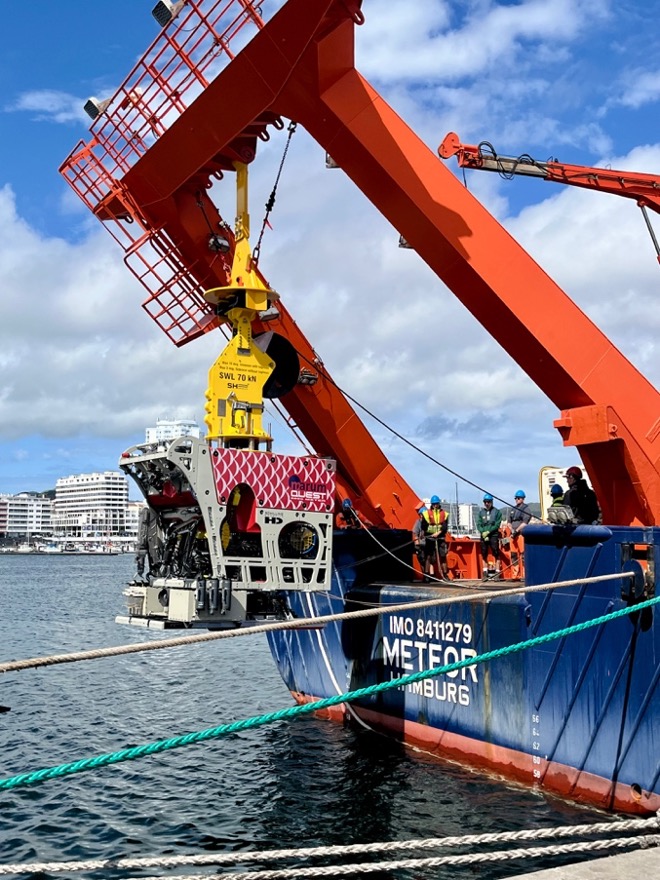
To investigate these processes, the new MARUM-QUEST 5000 remotely operated vehicle (ROV) performed its inaugural dives during the expedition. Equipped with the Kiel Pumping System (KIPS) and trace-metal-clean Go-Flo bottles, the ROV enabled the collection of uncontaminated fluid, biological, and geological samples directly from hydrothermal sources. In addition, the custom-designed trace metal clean Rosette sampler (TMR) from MARUM was deployed from the ship to acquire water column samples above the active vent sites, minimizing contamination and allowing for accurate quantification of trace metal concentrations to further understand the non-buoyant plume of hydrothermal systems.
Our main research questions are: :
- What are the dominant transport pathways for trace metals in MAR hydrothermal systems?
- How do gradients in pressure and temperature influence the speciation and reactivity of these metals?
- What roles do metal-to-sulfide and metal-to-carbon ratios play in determining metal mobility and their interactions with hydrothermal microbial communities?
We are particularly interested in characterizing biogeochemical transformations within rising and spreading hydrothermal plumes. These plumes, driven by buoyant vent fluids, experience steep thermal and redox gradients that induce extensive particle formation and aggregation. The MAR thus serves as a natural laboratory for investigating in situ the coupling between fluid chemistry, particulate dynamics, and microbial ecology.
The first dive at the Menez Gwen hydrothermal field marked a significant milestone for the team, as live footage from the seafloor illuminated the ROV’s descent into an alien yet profoundly significant ecosystem. This was followed by a second dive at the Rainbow hydrothermal field, where the team observed complex sulfide structures and thriving biological communities, including mussels and shrimp that flourish in these extreme environments. After the dive, our team sprang into action, retrieving and processing samples collected via the KIPS system and GoFlow bottles.
The last dive in the Rainbow Pits area targeted the retrieval of a long-term seafloor observatory deployed during a previous expedition. After two years of autonomous data collection, the observatory was successfully recovered – its surface encrusted with mussels, now destined for symbiosis studies.
Adverse weather conditions curtailed further ROV operations, redirecting efforts toward extensive CTD (conductivity-temperature-depth) profiling, Tow-Yo deployments, and high-resolution seafloor mapping. The MARUM-owned trace metal clean Rosette, now on its third cruise, continued sampling hydrothermal plumes for research questions that have only recently become tractable thanks to advances in trace metal clean technology. Meanwhile, in situ pumps quietly filtered microbial communities from the deep sea, providing insights into the biological dimension of hydrothermal circulation.
Operating beneath the photic zone – where sunlight is absent, and pressures are extreme – this research traces the evolution and transformation of hydrothermal plumes along the MAR. At this interface between geochemistry and biology, we uncover key processes that inform both the formation of seafloor mineral deposits and the biogeochemical cycling of elements critical to oceanic and planetary systems.
As we approach Las Palmas, Gran Canaria, for disembarkation on May 27th, we do so with not only a diverse array of scientific samples, but also a renewed appreciation for the dynamic processes shaping the ocean floor. The Mid-Atlantic Ridge, a site of ongoing oceanic crust renewal, continues to reveal its secrets – reminding us that the deep ocean remains one of Earth’s final frontiers.