Ongoing research projects
In the Deep Sea Sampling project headed by Bauer Maschinenbau, a minimally invasive extracting technology is being developed for vertical mining of massive sulphide deposits in the deep sea. Our part of the project focusses on developing the technology and monitoring concept to quantify the emissions of heavy metals and particles to the surrounding water to develop effective monitoring and mitigation concepts in potential future applications of massive sulphide minig.

M206 – Amazon-GEOTRACES-2 (Dry Season)

The Amazon-GEOTRACES -2 project studies interactions of trace metals with dissolved organic matter and colloids in the Amazon and Pará River estuaries and associated plumes as well as the mangrove belt south of the Pará as key processes for trace metal fluxes into the Atlantic. This cruise takes place during the dry season as a comparison to the previous cruise M147 during the wet season in 2018.
Within the PROBRAL exchange program of DAAD and CAPES, we have a longstanding collaboration with several working groups at brazilian institutions involving exchange of PhD students and PostDocs as well as joint sampling campaigns in the amazon estuarine area and mangrove belt of northeastern Brazil..
Magma-Sediment Interaction at the Ultraslow-Spreading Knipovich Ridge
In this project, we study the recently discovered Jøtul Hydrothermal Field by sampling the hydrothermal fluids and rising plume during research cruise MSM131 (RV Maria S. Merian, 2024).

The Kairei Hydrothermal Plume at the Central Indian Ridge
Official Title: “Ramifications of Venting at the Kairei Hydrothermal Field for Bathypelagic Microbial Processes in Consort with Carbon and Metal Cycling” (KABA).The aim of this program is to determine the biogeochemical cycling in the bathypelagic ocean above the Kairei Hydrothermal Field (KHF) and to understand how the hydrothermal fluids affect microbial life. For this project, we sampled the hydrothermal plume of the KHF during research cruise SO301 (RV Sonne, 2023/24) to analyze trace metal distribution and speciation.
Dynamics of Ore Metals Enrichment (DOME)
This project studies the role of p-T conditions, host rock lithology, phase separation, and organic compounds on metal mobility and metal sulfide deposition in spatially resolved hydrothermal vent areas.
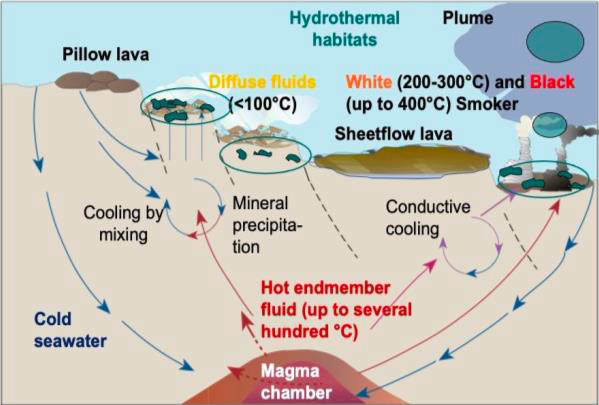

In this project, we investigate and sample shallow and deep sea hydrothermal outflow and venting in the Mediterranean close to the island of Milos during cruise M192 (RV Meteor, 2023). The cruise was be separated into two parts. The first part of the cruise was be dedicated to localizing the hydrothermal sites along a depth profile from 10m to 900m depth. During the second half of the cruise, the participants sampled the newly discovered vent sites for fluids, rocks, fauna and sediments. The topic of our team is the geochemistry of hydrothermal fluids and plumes with focus on trace metals and their interactions with organisms.
Studying the Distribution of Venting Along the Mid-Atlantic Ridge (29–38°N) and Implications for Hydrothermal Exchange and Vent Ecosystems during research cruise M190 (RV Meteor, 2023) and M210 (RV Meteor, 2025).

The RainbowPlume project, led by GEOMAR Helmholtz-Centre for Ocean Research Kiel, aims at obtaining a mechanistic and quantitative understanding of the processes that set the hydrothermal flux of trace elements and their isotopes (TEI) at the Rainbow vent field on the Mid-Atlantic Ridge near the Azores. It is associated with the research cruise M176-2 and forms part of the GEOTRACES initiative.
TRAM is short for “Tracing origin and distribution of geogenic and anthropogenic dissolved and particulate critical high-technology metals in the southern North Sea”. The project, associated with the Meteor Cruise M169 under the lead of Prof. Dr. Andrea Koschinsky (chief scientist) to the North Sea is a joint project of the Koschinsky, Thomsen, Bau, Ullrich, and Unnithan Group at Jacobs University, the German Federal Institute for Geosciences and Resources (BGR) and Christian-Albrechts-University Kiel.


The Equatorial Pacific GEOTRACES project explores dissolved trace element concentration and speciation in the Equatorial Pacific Ocean. For this project, a transect was sampled across the Equatorial Pacific Ocean from Ecuador to Australia during research cruise SO298 (RV Sonne, 2023).
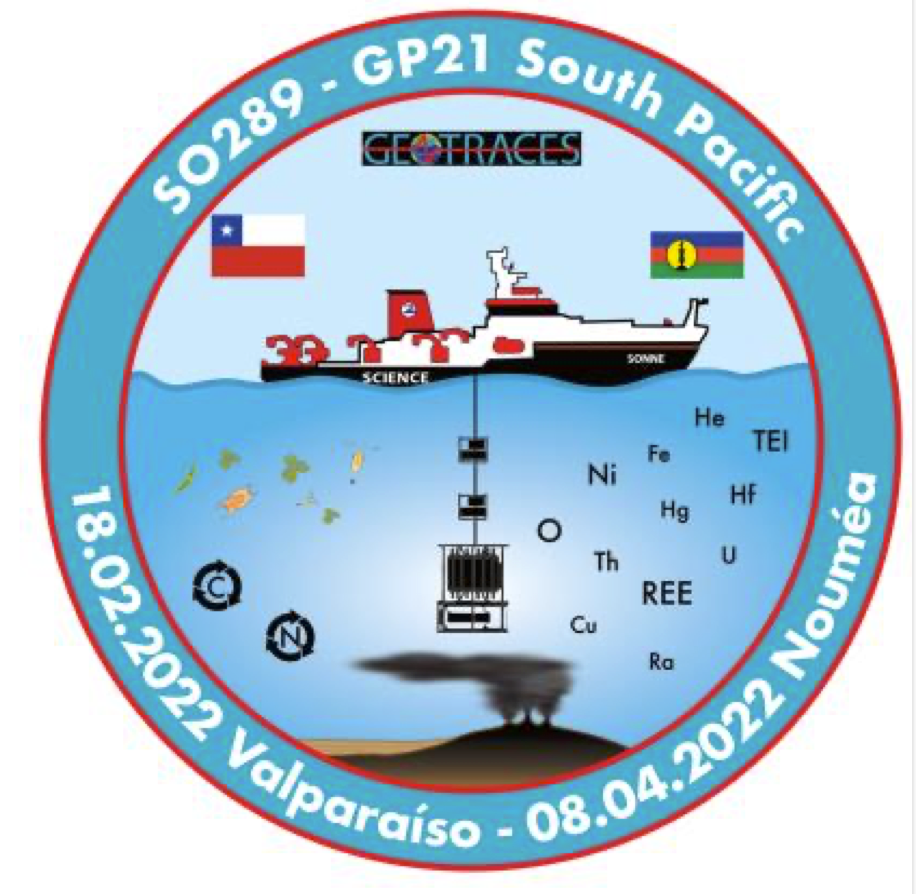
The South Pacific GEOTRACES project explores dissolved trace element concentration and speciation in the South Pacific Ocean. For this project, a transect was sampled across the South Pacific Ocean from Chile to New Caledonia during research cruise SO289 (RV Sonne, 2022).

The Amazon GEOTRACES project studies interactions of trace metals with dissolved organic matter and colloids in the Amazon and Pará River estuaries and associated plumes as key processes for trace metal fluxes into the Atlantic.
Past research projects– under construction
MiningImpact – Environmental Impacts and Risks of Deep-Sea Mining
(MiningImpact Phase 2)
The MiningImpact project, led by GEOMAR Helmholtz-Centre for Ocean Research Kiel, aims at studying the biological and biogeochemical impacts associated with the mining of marine mineral resources in the deep seabed.
MiningImpact – Ecological Aspects of Deep-Sea Mining
(MiningImpact – Phase 1)
The JPI Oceans Pilot Action “Ecological Aspects of Deep-Sea Mining” assessed the ecological impacts which could arise from commercial mining activities in the deep sea. Please find more information about MI1.