Research Interests:
Processes controlling the concentration and availability of biologically relevant trace elements to the ocean (e.g. Fe/Cu//NiZn) including their behavior at transition zones like estuaries and hydrothermal systems with regards to particle adsorption, redox speciation and complexation by organic ligands.
Lowering barriers of access to scientific research through development of low-cost open source electrochemical methods i.e. for in-situ voltammetric measurements.
PostDoc project:
While finishing the last phase of my PhD, I am currently already working in the PostDoc- project for Deep Sea Sampling II. In this project, I am developing parts of the environmental monitoring concept for the exploration of massive sulfide deposits including the use of in-situ voltammetric measurements of labile Cd, Cu, Pb, and Zn alongside measurements of particles and geochemical parameters to investigate potential emissions to the ocean of exploration activities:
PhD project:
Organic complexation of Ni and other trace metals (such as Fe and Cu) in geochemical transition zones by voltammetric methods
Within my PhD project, I am studying the behavior of trace metals, such as nickel (Ni), copper (Cu), and iron (Fe) at marine geochemical transition zones. Trace metals act as micro nutrients to marine phytoplankton and are present in such low concentrations in seawater that their availability can limit the growth of certain species, thus acting as a significant control parameter for the marine food web. At these transition zones, including estuaries, hydrothermal vents and the sediment-water interface, the investigated trace metals experience significant changes in the geochemical regime, affecting their chemical behavior as they are transported into the ocean or removed from the water column. Particularly the adsorption and desorption to/from particulate material and the complexation by organic ligands strongly affect the fate of trace metals entering the marine geochemical system.
I investigate these processes by analysis of different size fractions after sequential filtration and CLE-AdCSV (competitive ligand exchange – adsorptive cathodic stripping voltammetry) experiments for the determination of ligand concentrations and complexation constants. My work focusses on the analysis of water samples from hydrothermal plumes of the Kairei hydrothermal vent field as well as the Amazon river estuary.
Method development & 3D-printing
To improve the analytical output of my measurements, I put a lot of effort into automating the voltammetric measurements and reducing the necessary sample volume for organic complexation measurements which is often a limiting factor in marine research projects. To achieve this, I intially had a few custom components 3D-printed as prototypes by an external supplier. I quickly realized the potential of easy fabrication of custom lab supplies and components for analytical systems. THis is particularly advantageous in a trace metal lab where contamination from metal parts is a constant risk. This lead to acquisition of our own 3D-printers and I am now 3D-printing a variety of custom parts for the lab and my automated voltammetric system. While most parts are highly specialized for our particular setup, I have shared a few designs that might be useful for other labs as well here:
https://www.printables.com/@nfroehberg
MARUM Trace Metal Rosette (TMR)
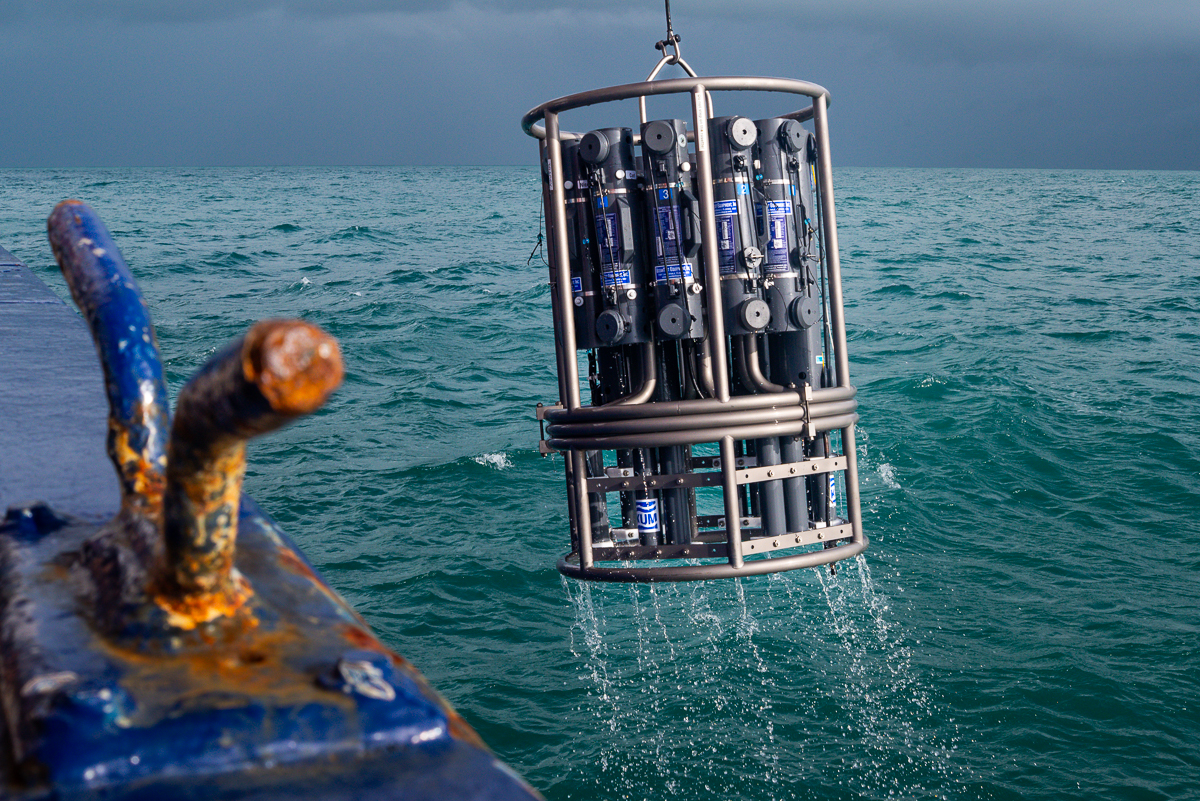
I was heavily involved in the technical concept for the trace metal rosette that was acquired by MARUM in 2023. This system is designed to obtain water samples with inimized risk of trace metal contamination from the water column of the ocean using the aramide ropes available on all the major German research vessels. These ropes do not have a conductor for active control during deployment like the steel cables used for regular sampling devices therefore requiring autonomous operation. The TMR has a titanium frame and 12 5L contamination free water samples. The control unit operates autonomously and can trigger the water samplers at pre-programmed depths or times. We have used this system very successfully to sample the hydrothermal plume at the Kairei vent field during cruise SO301 as well as the Amazon outflow during cruise M206 (see below) where I was responsible for operation of the device on board.
Participation in ongoing projects:
RV METEOR (M206) research cruise to the Amazon Estuary, November-December 2024
During research cruise M206 (AMAZON-GEOTRACES-2) we investigate the outflow of trace metals and dissolved organic material into the Atlantic in the Amazon estuary during the dry season (as compared to the wet season sampling of the first AMAZON-GEOTRACES cruise during the wet season). During this cruise, I was responsible for the trace metal clean water column sampling and supported the station planning and on-board sample processing.
https://andrea-koschinsky.org/category/m206/
PROBRAL sampling campaign in the mangroves near Braganca (Northeast Brazil) November 2024
Within the PROBRAL academic exchange project, we sampled the mangroves and rivers around Braganca in Northeast Brazil to complement our shipboard sampling of the Amazon estuary during cruise M206. For this campaign, I designed and produced large metal-free filter holders and portable peristaltic pumps that allowed us to quickly acquire filtered water samples directly in the field without risk of trace metal contamination.
RV SONNE (SO301) research cruise to the Kairei Hydrothermal Vent Field (Central Indian Ridge, November 2023 to January 2024
First deployment of the new MARUM Trace Metal Rosette (TMR) water sampler to investigate the inputs of the Kairei hydrothermal plume to the deep ocean by detailed sampling of the water column surrounding the Kairei hydrothermal vent field.
RV SONNE (SO289) research cruise to the South Pacific (GEOTRACES), February-April 2022
On board: Acquisition of seawater samples as well as sequential filtration and ultrafiltration for various parameters to be analyzed in the lab of Prof. Koschinsky.
Blog from the cruise: https://www.oceanblogs.org/geotraces/
RV METEOR (M174) research cruise to the Amazon Estuary, March-May 2021
On board: Acquisition of surface water, sediment, and porewater samples for analysis of concentrations and organic complexation of trace metals during estuarine mixing. Mixing experiment using seawater and Amazon river water endmembers.
Laboratory: Measurements of Ni-binding ligands in surface water and porewater samples using CLE-AdCSV.
Blog from the cruise: https://www.io-warnemuende.de/rv-meteor-m174-2021.html
RV MARIA S. MERIAN (MSM96) research cruise Metal-ML to the Porcupine & Iberian Abyssal Plains, October-November 2021
On board: Acquisition of sediment and porewater samples from the abyssal plains as well as surface water samples from the Weser estuary and North Atlantic. Voltammetric measurements of dissolved oxygen across the sediment water interface in sediment cores.
Laboratory: Mixing experiment using seawater and Weser river water endmembers. Measurements of Ni-binding ligands in porewater samples and samples from mixing experiment using rCLE-AdCSV.
Blog from the cruise: https://www.oceanblogs.org/msm96/
RV METEOR (M147) research cruise Amazon-Geotraces (DFG) to the Amazon Estuary, May 2018
Laboratory: Measurements of Ni-binding ligands in surface water samples using rCLE-AdCSV.
Short cruise report: https://www.bodc.ac.uk/resources/inventories/cruise_inventory/reports/meteor_m147.pdf
Journal Publications:
Fröhberg, N., Schmidt, K., Poehle, S., Pedre, I., Walter, M., Mette, J., Fuchs, S., Garbe-Schönberg, D., Kleint, C., & Koschinsky, A. (2026). From source to sink: complex dual role of the Kairei hydrothermal plume in deep ocean trace metal cycling at the Central Indian Ridge. Geochimica et Cosmochimica Acta, 432, 242–271. https://doi.org/10.1016/j.gca.2026.09.018
Paul, S. A., Gutjahr, M., Xu, A., Fröhberg, N., Hathorne, E., Scholz, F., & Frank, M. (2025). The Nd isotope composition of oxic pore waters of marine sediments and implications for its use as a past water mass proxy. Geochimica et Cosmochimica Acta, 410, 141–159. https://doi.org/10.1016/j.gca.2025.10.005
Fröhberg, N., Hollister, A., & Koschinsky, A. (2025). Simple automation and volume reduction of voltammetric measurements for marine trace metal speciation. Electroanalysis, 37, e70060. https://doi.org/10.1002/elan.70060
Pedre, I., Fröhberg, N., Waska, H., Koschinsky, A., & Pahnke, K. (2024). Simple and affordable colorimetric sensing strips for quantitative determination of total manganese in porewater samples. Limnology and Oceanography: Methods, 22, 484–494. https://doi.org/10.1002/lom3.10615
Fröhberg, N., & Paul, S. (2021). Porewater oxygen profiles in surface sediments of the North Atlantic Basin during RV Maria S. Merian cruise MSM96. PANGAEA. https://doi.org/10.1594/pangaea.931647
Donald, H. K., Foster, G. L., Fröhberg, N., Swann, G. E. A., Poulton, A. J., Moore, C. M., & Humphreys, M. P. (2020). The pH dependency of the boron isotopic composition of diatom opal (Thalassiosira weissflogii). Biogeosciences, 17, 2825–2837. https://doi.org/10.5194/bg-17-2825-2020
Kleint, C., Bach, W., Diehl, A., Fröhberg, N., Garbe-Schönberg, D., Hartmann, J. F., de Ronde, C. E. J., Sander, S. G., Strauss, H., Stucker, V., Thal, J., Zitoun, R., & Koschinsky, A. (2019). Geochemical characterization of highly diverse hydrothermal fluids from volcanic vent systems of the Kermadec intraoceanic arc. Chemical Geology, 528, 119289. https://doi.org/10.1016/j.chemgeo.2019.119289
Conference Presentations:
Fröhberg, N., Schmidt, K., Poehle, S., Pedre, I., Walter, M., Mette, J., Fuchs, S., Garbe-Schönberg, D., Kleint, C., & Koschinsky, A. (2026). From source to sink: complex dual role of the Kairei hydrothermal plume in deep ocean trace metal cycling at the Central Indian Ridge. 2026 Ocean Sciences Meeting, Glasgow, UK (Poster). https://agu.confex.com/agu/osm26/meetingapp.cgi/Paper/2041040
Krause, C. H., Fröhberg, N. (presenting author), de Carvalho, L. M., Schneider, A. B., & Koschinsky, A. (2026). Reactive dissolved nickel distribution in the Northwest Brazilian Continental Shelf: high versus low river discharge periods and the specific role of mangrove forests. XVII International Estuarine Biogeochemistry Symposium, Lisbon, Portugal (Talk). Book of abstracts
Koschinsky, A., Hollister, A., Kelly, C., Schneider, A. B., Fröhberg, N., Krause, C. H., & de Carvalho, L. M. (2026). Biogeochemical processes and fluxes of trace metals from the Amazon-Pará river system and the mangrove belt into the Atlantic: high and low discharge conditions compared. XVII International Estuarine Biogeochemistry Symposium, Lisbon, Portugal (Talk). Book of abstracts
Koschinsky, A., Hollister, A., Poehle, S., Fröhberg, N., Carvalho, L., Schneider, A., Gledhill, M., & Frank, M. (2025). Biogeochemical processes and fluxes of trace metals from the Amazon River system and mangrove belt into the Atlantic under high and low discharge conditions. Goldschmidt Conference, Prague, Czech Republic (Talk). https://conf.goldschmidt.info/goldschmidt/2025/meetingapp.cgi/Paper/29916
Kelly, C., Hollister, A., Fröhberg, N., & Koschinsky, A. (2025). Copper-binding ligands and copper concentrations in the Amazon and Pará River estuaries. Goldschmidt Conference, Prague, Czech Republic (Talk). https://conf.goldschmidt.info/goldschmidt/2025/meetingapp.cgi/Paper/31468
Gallucci, L., Fröhberg, N., Malik, S. A., Mette, J., Wegener, G., Koschinsky, A., Walter, M., Amann, R., & Meyerdierks, A. (2025). Meta-omics mining of active microbial communities in hydrogen and iron-rich deep-sea hydrothermal plumes. Goldschmidt Conference, Prague, Czech Republic (Poster). https://conf.goldschmidt.info/goldschmidt/2025/meetingapp.cgi/Paper/32185
Fröhberg, N., de Carvalho, L. M., & Koschinsky, A. (2023). The role of physical and chemical nickel speciation in the Amazon estuary for input of Ni into the Atlantic. XVI International Estuarine Biogeochemistry Symposium, Šibenik, Croatia (Poster).
Fröhberg, N., Klose, L., & Koschinsky, A. (2022). Organic complexation of Ni in the hydrothermal plume of the Rainbow vent field. Goldschmidt Conference, Honolulu, USA (Talk, online). https://doi.org/10.46427/gold2022.11348
Fröhberg, N., Glazer, B., & Lio, S. (2019). Development of a low-cost open-source potentiostat for in-situ electrochemical measurements. ICYMARE 2019, Bremen, Germany (Talk).
Kleint, C., Fröhberg, N., Zitoun, R., Sander, S., Strauss, H., & Koschinsky, A. (2017). Diversity of hydrothermal fluids from four vent sites at the Kermadec Island Arc and its relevance for elemental fluxes. Goldschmidt Conference, Paris, France (Talk).

Sample filtration during SO289. 
Voltammetric profiling of oxygen concentrations in sediment cores during MSM96. 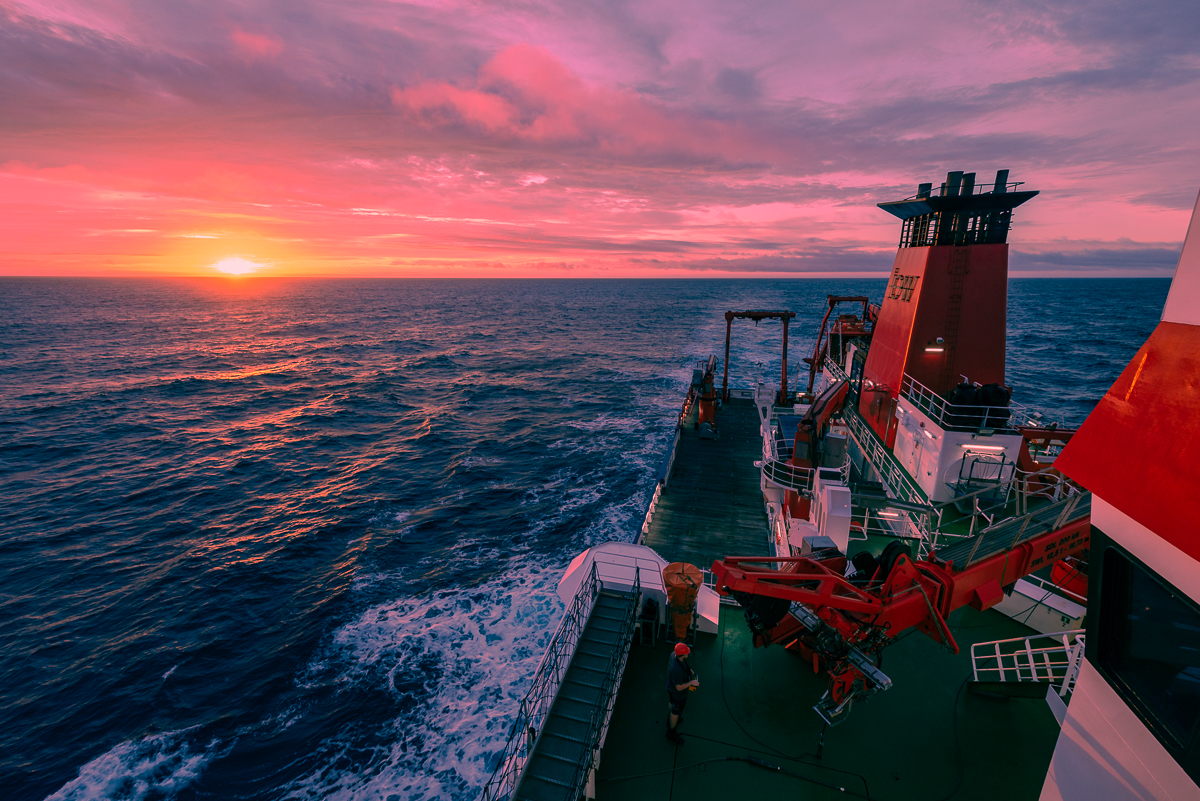
Sunrise aboard RV Maria S. Merian. 
Surface water sampling in the Amazon estuary during M174. 
Sediment Sampling during M174. 
Trace metal-clean sample processing in the ship-board lab of RV Meteor. 
Surface water sampling in the Amazon estuary during M174. 
Sunset aboard RV Meteor. 
Loading of the GEOMAR TMR during SO289. 
TMR deployment in rough weather during SO289. 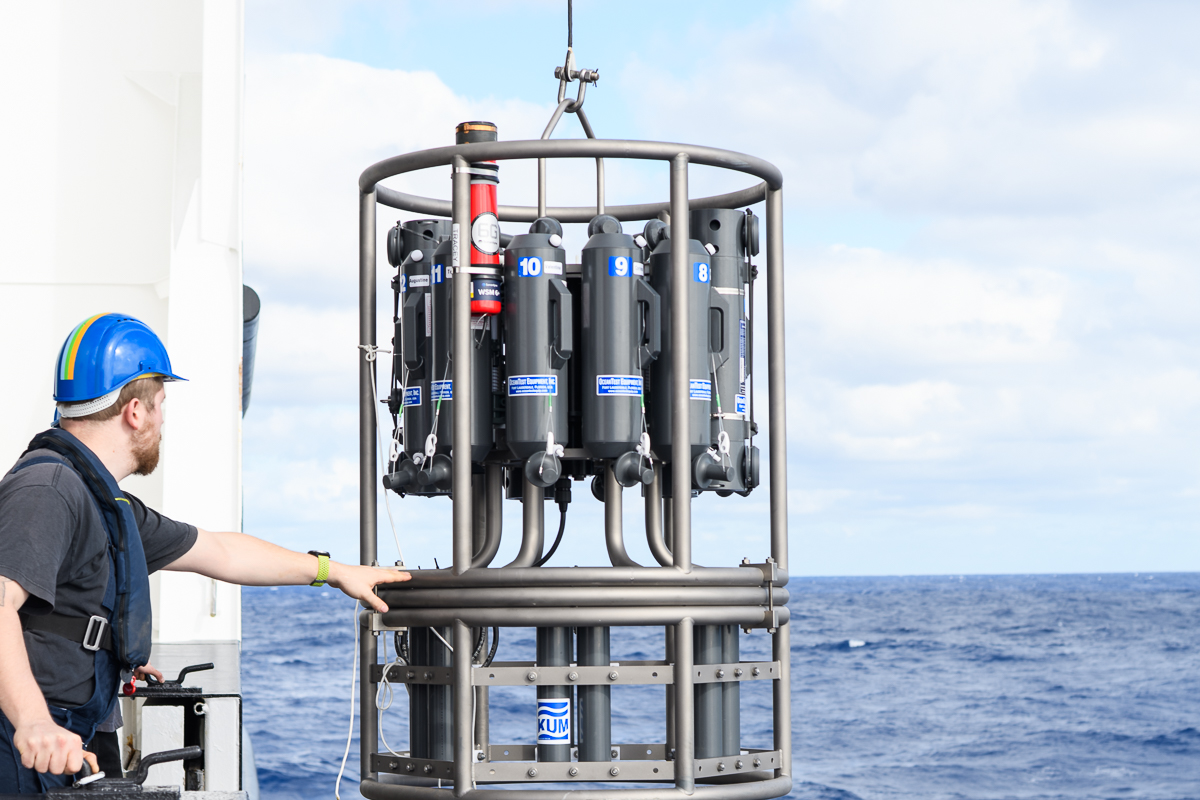
Deployment of the MARUM TMR during SO301 
TMR maintenance during M206. 
Filtration of Porewater in the mangroves of Northeast Brazil for the PROBRAL project. 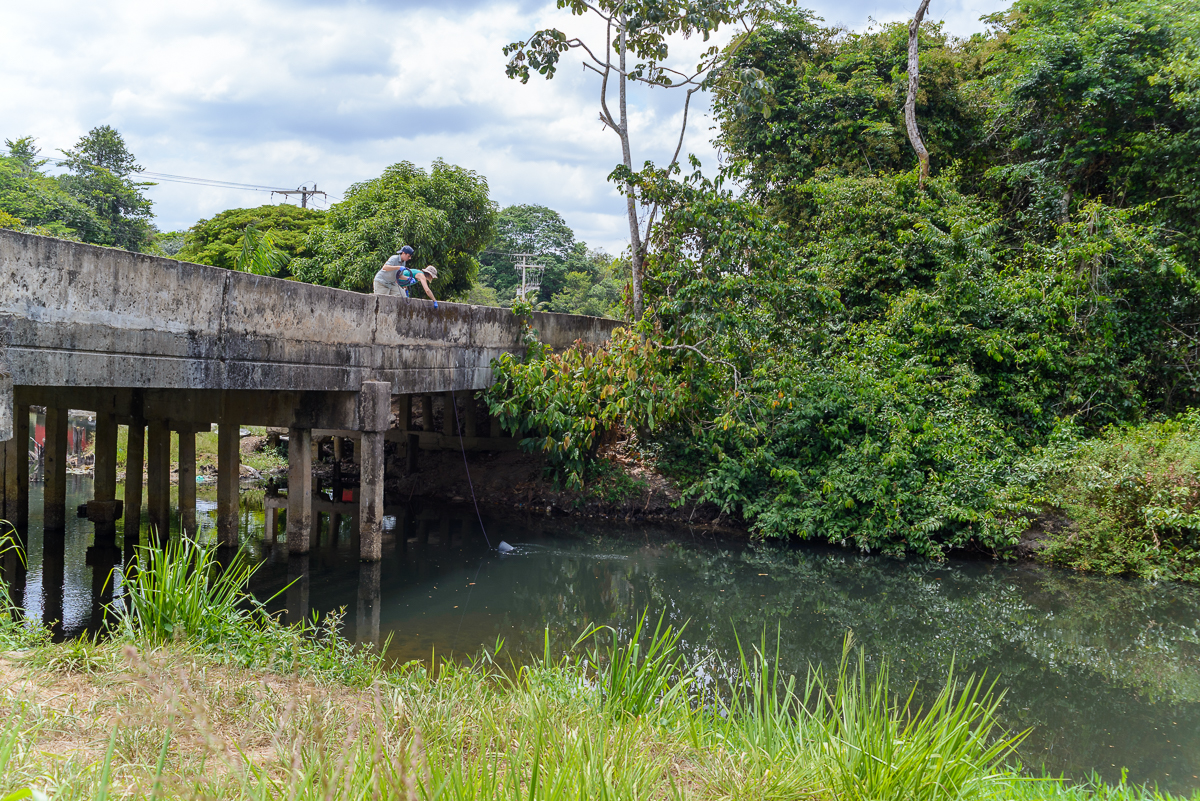
Sampling the Caeté river in Northeast Brazil for the PROBRAL project. 
Processing water samples from the Caeté river.