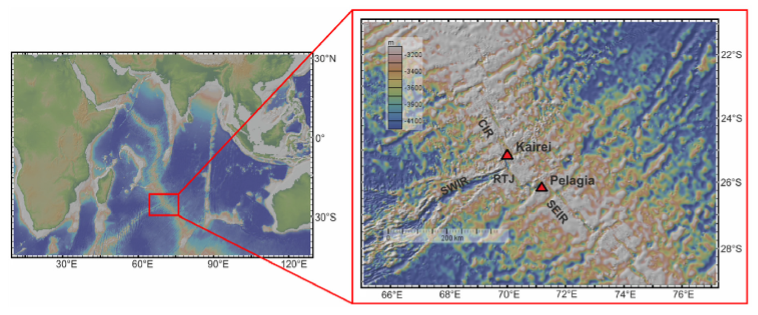
The Kairei vent field (KHF) was the first hydrothermal field discovered in the Indian Ocean. It is located 24 km north of the first segment of the Rodriguez Triple Junction (25°19.32´S, 70°02.67´E), on the Central Indian Ridge (Figure 1), and it is part of the German license area for massive sulphide exploration of the BGR Hanover (Federal Institute for Geosciences and Natural Resources). Over the past two decades, fluids emanating from these vents continuously presented temperatures higher than 360 °C, as well as high metal concentrations such as iron, manganese, copper and zinc. In addition, elevated chloride ion concentrations have been reported for this system, which suggests subsurface brine formation through phase separation under super-critical conditions [1].
The aim of this program is to determine the biogeochemical cycling in the bathypelagic ocean above the KHF and to understand how the hydrothermal fluids affect microbial life. More specifically, we intend to answer the following questions in an interdisciplinary approach, in which geochemists, microbiologists and physical oceanographers from Constructor University, University of Bremen and Max Planck Institute for Marine Microbiology are involved.
- What is the heat flux of the plume and how does the plume spread?
- What metals and gases are emitted from the hydrothermal vent and how do they propagate in the water column?
- How do high-energy plume components affect deep-sea microbial communities?
To answer these questions, samples of the Kairei hydrothermal plume collected in the frame of the RV Sonne SO301 expedition (as a secondary user project of the cruise led by BGR) are studied. Samples were collected in four CTD transects in a spoke wheel-like fashion and in a 17 km survey in NW-SE direction. The CTDs were equipped with turbidity, redox and MAPR sensors. After contours were mapped, additional hydrocasts allowed us, in collaboration with colleagues from the University of Bremen, to monitor temporal variability and current velocities and to sample plume waters along vertical and horizontal profiles. Collected samples are analysed for parameters such as trace metals, organic ligands, major anions and dissolved organic carbon. Furthermore, to study the adsorption of trace metals onto colloidal suspended material, sequential filtrations are carried out and the resulting fractions are analysed.
The data collected help us understand the fluxes of metals in the study area. In this part of the project, the new trace metal rosette (“Tracey”) from MARUM is used for her first deployment.

Finally, incubation experiments with plume water performed by Dr Anke Meyerdierks´s group (Max Planck Institute for Marine Microbiology) provide information on the microbial fixation of inorganic carbon and help characterize the abundance and activity of the various microorganisms in the plumes. In addition, determination of hydrogen and methane by means of chromatographic methodologies by Dr Gunter Wegener´s group, from Bremen University, give additional information on microbial activity.
All the gathered data will provide unprecedented insights into plume dispersion and mixing processes, plume particle formation, particle-organic-microbe interactions and consequences for biogeochemical cycling, as well as microbial metabolism in the plume and its role in determining the fate of micronutrients in the bathypelagic ocean.
[1] Noowong et al., 2021. Imprint of Kairei and Pelagia deep-sea hydrothermal systems (Indian Ocean) on marine dissolved organic matter, Organic Geochemistry 152 (2021) 104141. 10.1016/j.orggeochem.2020.104141