Complementary to the Amazon-GEOTRACES-2 project, that will investigate the outflow of the Amazon river to the Atlantic Ocean in December, a team of three group members (Adrian Hollister, Sandra Pöhle, and Nico Fröhberg), has begun sampling the mangrove forests and different freshwater inputs east of the Amazon estuary in cooperation with partners from GEOMAR, the University of Oldenburg, Universidade Federal do Pará, and Universidade Estadual do Norte Fluminense.
After arrival in Braganca, a small city in the north Brazilian state Pará, on the evening of 15.11.24, we began our PROBRAL sampling campaign in the Caeté River and its estuary the next day. With the focus on trace metal speciation and interaction with organic matter, we collected samples for analysis of dissolved trace metals, metal-binding organic ligands, dissolved organic carbon, and humic substances (a major fraction of terrestrially-derived dissolved organic matter). All samples were filtered on-site using a portable pump specifically designed for such expeditions by Nico. We also saved the filters for particle analysis.
Our group split into two: a small boat to sample in the lower-salinity region, and a large boat to sample in the higher-salinity area. The group on the large boat sampled in the higher-salinity area around the bay of the Caeté River at ebb and flood tide, though the salinity gradient in this bay was surprisingly small (~35 to ~32). Even at the highest salinity, the water was visibly turbid and the filters showed a high particle load. The weather was good, but the water at the offshore-most stations was very choppy, adding additional challenges to filtering in a such a small boat compared to our usual sampling on large research vessels. Nevertheless, we collected samples from all planned stations (4 total) and made it back to shore in the evening before dark. We enjoyed beach scenery, spotted scarlet ibises and even a dolphin during sampling.
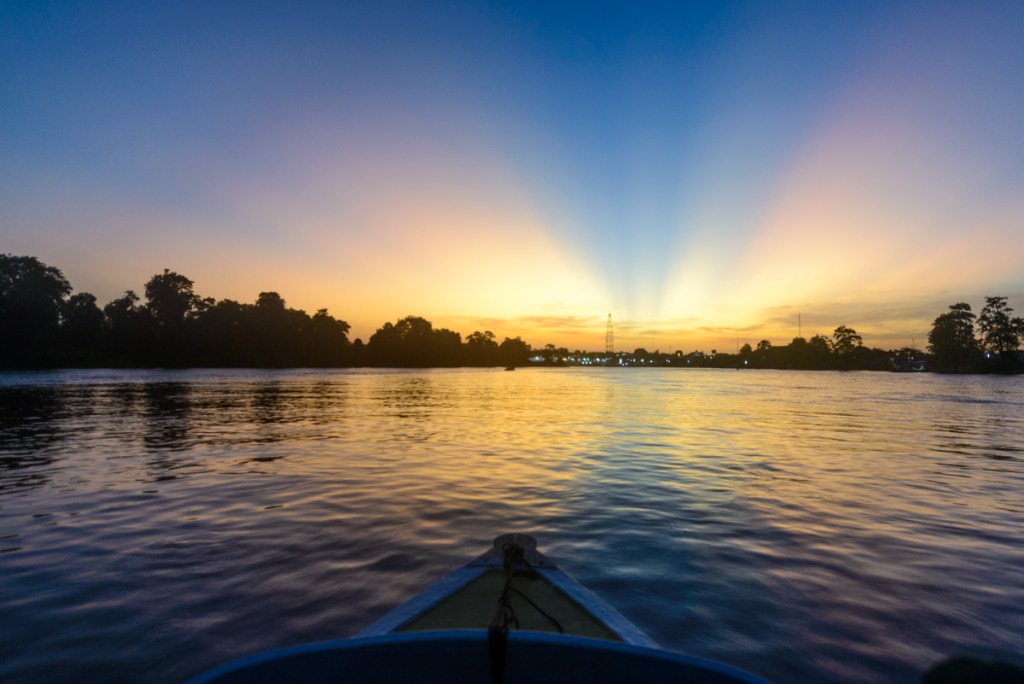
At the same time, the smaller boat started to sample in the middle of the estuary to go upstream into the Caeté river. While conditions there were calmer, the smaller boat made the sample processing for our trace metal analyses a new challenge compared to working on the large research vessels, we usually use for marine research. As Brazil is currently experiencing an extreme dry season with very little rainfall, freshwater levels and flow in the rivers is very low, so we only managed to get down to a salinity of 11.7 (compared to 35 in seawater and 0 in freshwater) on this day with another 6 sampling stations. But we will continue our sampling trip and travel further upstream to get samples from the freshwater endmember at zero salinity as well as different streams and porewaters in the surrounding area and mangrove forests along the coast.