Adrian Hollister, together with Morgane Léon, Jan Scholten, Pieter van Beek, Martha Gledhill and Andrea Koschinsky, recently published a study titled “Trace metals in the Amazon-Pará River estuary and Brazilian continental shelf: Estimate of the chemical fluxes into the Atlantic Ocean” in the journal Estuarine, Coastal and Shelf Science.
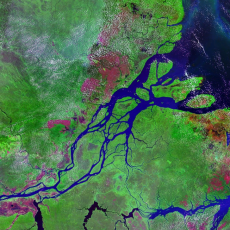
The Amazon is the largest river on Earth, yet the dissolved trace metal fluxes leaving its estuary had remained unknown. Based on samples from GEOTRACES cruise M147 (RV Meteor, April–May 2018), the study provides the first flux estimates for nine dissolved trace metals (Al, Mn, Fe, Co, Ni, Cu, Zn, Cd and Pb) exported from the Amazon-Pará estuary into the Atlantic. Two independent approaches, an extrapolated trace metal-salinity mixing line and radium-228 as a flux gauge, gave comparable results and indicate that during the wet season the Amazon and Pará together supply an estimated 8–14% of global riverine nickel and 13–23% of copper, while contributing comparatively little manganese, iron, cobalt and zinc. The offset between the two methods for iron points to an additional source of iron from the shelf. Dry season data are still needed to complete the annual picture for this globally important and increasingly pressured system.
Check it out here: https://doi.org/10.1016/j.ecss.2026.110110